
What is mDecide?
mDecide is the platform an enterprise runs a recurring, high-stakes decision on. One decision (a well intervention, a capital gate, a quote, a batch release) is worked end to end by a team of people and AI agents, and the platform records what was decided, on what evidence, by whom, and what happened next. Leaders see cost, quality, and audit posture across every decision running on it.
It is the platform behind metricsIQ engagements, and it is available to run your own decisions.
The premise: humans bracket the loop
Most AI platforms ask you to trust an agent’s output. mDecide is built on a different division of labor: humans bracket the loop, and agents do the work in between.
- Humans frame the decision. What has to be decided, by when, and what is at stake.
- Agents gather the data, assemble the evidence, and surface options. Across the systems that sit behind the decision, typically five to twenty or more.
- Humans review and decide. With the full evidence trail, the alternatives that were weighed, and the option to override the recommendation.
- The platform records the decision and the outcome. The framing, the evidence, the recommendation, the human choice, and the measured result.
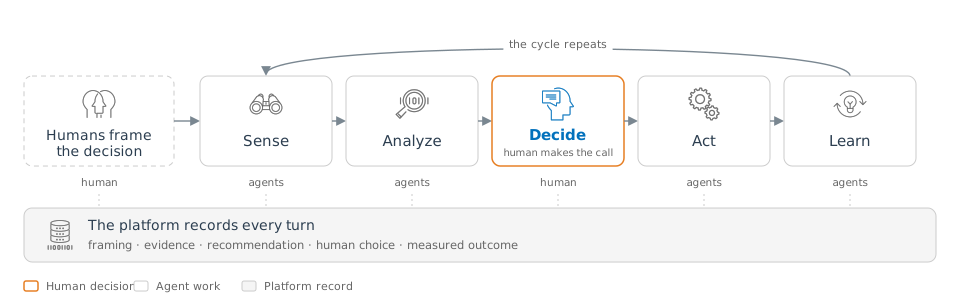
That last step is what distinguishes the platform from a dashboard or a chat surface. Most organizations discard the reasoning behind a decision once it is made. mDecide keeps it in a queryable record and feeds it into the next decision of the same kind, so a later decision starts with what earlier ones established. The record lives in your deployment and stays yours; its usefulness grows with the number of decisions run and how long they have been recorded.
The decision loop
Decisions on mDecide run through a repeatable, recorded cycle of five stages:
| Stage | What happens |
|---|---|
| Sense | Data is gathered from the operational systems that bear on the decision |
| Analyze | Conditions are evaluated against company-specific models, history, and constraints |
| Decide | A recommendation is put forward with alternatives and projected value; a human makes the call |
| Act | The chosen action is executed or initiated in the systems that carry it out |
| Learn | The realized outcome is measured against the projection and recorded |
A configured instance of this cycle for a particular decision is called a Decision Value Loop. People start the loop and make the call; agents do the work in between; every turn is captured. Core concepts covers the loop and its entities in detail, and the tour walks one loop through the product surface.
Who mDecide is for
mDecide is built for a particular class of decision. It fits when a decision has most of these characteristics:
- The evidence is scattered. The inputs live in five or more systems that no vendor pre-integrates: sensor histories, operational databases, engineering tools, documents, economic models, external feeds.
- Judgment is domain-specific. Getting it right requires understanding of the domain that a general-purpose model does not have.
- The rules are yours. Risk thresholds, escalation policy, and approval workflow are specific to your organization.
- It recurs. The same decision is made repeatedly, so a record of past instances has value for the next one.
- The stakes are quantifiable. The value of deciding well, or the cost of deciding badly, can be stated in money.
Decisions that sit entirely inside one system of record, or that happen once and never again, get less from the platform: there is little to integrate and little to accumulate.
Three roles typically evaluate mDecide together:
- The decision owner. The line-of-business or operations leader accountable for the decision and its results. Their test is whether the loop produces better calls than today’s process, and whether their people stay in control of them.
- The architect. CIO, CTO, CDO, or platform engineering. Their test is deployment shape, isolation, identity, data handling, and exit. See Architecture overview and Trust and security.
- The program leader. Often a CAIO or transformation lead, with finance alongside. Their test is whether decision cost, quality, and value are visible and reportable across a portfolio of decisions rather than one workflow.
What the platform includes
Five capabilities make up mDecide. Together they let a recurring, high-stakes decision run in production with people in charge and value tracked.
Decision Value Loop engine
The execution surface where a decision is actually worked: Sense, Analyze, Decide, Act, Learn. It is multiplayer by default (several people and several agents on the same decision), with structured decision capture, recorded alternatives, human overrides, and outcome tracking built into the surface rather than added afterward.
Decision Packs
A Decision Pack is a pre-configured collection of agents, tools, data connections, and process for one type of decision, so a deployment starts with the integrations, the domain vocabulary, and the decision structure already in place. Packs have been built for decisions including well intervention, pipeline integrity, manufacturing changeover, batch release, covenant monitoring, customer account intelligence, and scene triage. Which packs are available for your deployment, and what configuring one for your operation involves, is established during scoping.
Adaptive ontology tooling
Data integration, entity resolution, and shared business context across the systems a decision touches. It answers the questions agents have to agree on before they can work together: what counts as a well, what “decline rate” means across production data and reservoir models and economic systems, which record in one system is the same asset as a record in another.
It is adaptive in that the model is maintained as the business changes (new equipment types, reorganized units, an acquisition that brings its own terminology) rather than being fixed at integration time and breaking when the business moves. It is also what allows a decision in one workflow to draw on a decision recorded in another.
Bring your own agent
If your teams have already built agents in LangChain, LangGraph, Amazon Bedrock, AutoGen, or a custom framework, they connect to mDecide through open standards (MCP, A2A). A governance wrapper gives them the same authentication, audit logging, decision capture, and access controls as the agents metricsIQ delivers. Existing agent work is not stranded, and it cannot route around the governance contract to get its work done.
Admin and portfolio
The operator’s view across every decision running on the platform: cost per decision, decision quality, override rate, decision velocity, and audit posture, rolled up live, with monitoring and alerting underneath. This is the surface a program leader uses to run a portfolio of decisions, as distinct from the loop surface where one decision gets worked.
A note on agents
mDecide ships specialized agents: decision facilitation, an ontology bridge that aligns data from different systems into a shared vocabulary, and data-product creation with full provenance. They are deliberately not given personas or names. The focus stays on the decision and the person who owns it.
How it is delivered
mDecide is deployed single-tenant: one dedicated AWS environment per customer, in the region that fits your data-residency requirements, with no data comingled across customers. Connections to your source systems are read-only, so adopting the platform does not require a migration or a data-platform program to finish first. Agent reasoning is served by Anthropic Claude through Amazon Bedrock; the platform is not tied to a single model.
Encryption in transit and at rest, role-based access, multi-factor authentication, and audit logging are part of the deployment rather than later additions.
The platform builds on open standards (MCP, A2A, OASF) and keeps decision records portable, so the exit path is explicit: your data, your ontology, your integrations, and your decision history come with you if you leave.
Architecture overview covers the deployment in detail; Trust and security covers controls, data handling, and the responsibility split.
Where to go next
- Core concepts: the vocabulary the rest of the documentation uses.
- Tour: one decision cycle: one decision, start to finish, in the product.
- Adopting mDecide: how organizations move from a single anchor decision to production.